Car Battery in India: Complete Guide to Replacement, Maintenance & Buying

Car Battery in India

Your car battery is the most quietly critical component under the bonnet. It starts the engine, powers every electronic system in the car, and stabilises voltage across the entire electrical circuit. When it fails - and in India's conditions, it can fail faster than you'd expect - it rarely gives much warning.

Most Indian car owners replace their battery only after a breakdown. That reactive approach costs more and causes more inconvenience than necessary. This guide covers everything you need to know - how car batteries work, how long they last in Indian conditions, how to spot the warning signs early, how to replace one, and how to make yours last as long as possible.

What Is a Car Battery?

A car battery is a rechargeable lead-acid unit that supplies the electrical energy needed to start your vehicle's engine and run its onboard electronics - lights, infotainment, AC controls, sensors, and more. Once the engine is running, the alternator takes over and recharges the battery simultaneously.

The standard car battery in most Indian vehicles is a 12-volt lead-acid battery, typically rated between 35Ah and 80Ah depending on the car's size and power demands. The battery doesn't just start the car - it acts as a buffer for the entire electrical system, absorbing voltage spikes and ensuring stable power delivery to every component.

Understanding Car Battery Technology

Not all car batteries are built the same. Understanding the types helps you make a better buying decision:

Battery TypeBest ForMaintenanceLifespan
Flooded Lead-Acid (FLA)Budget-conscious buyers, older carsRequires distilled water top-up2-4 years in India
VRLA / Sealed (MF)Most modern cars, city drivingMaintenance-free3-5 years
AGM (Absorbent Glass Mat)SUVs, start-stop systems, premium carsMaintenance-free, spill-proof4-6 years
EFB (Enhanced Flooded Battery)Entry-level start-stop vehiclesLow maintenance3-5 years
Lithium-IonEVs and hybrids onlyNone8-10 years

For most Indian car owners driving petrol or diesel vehicles, a sealed maintenance-free (MF) or AGM battery is the most practical choice. AGM batteries handle India's heat and frequent engine restarts significantly better than conventional flooded batteries.

How India's Climate Affects Your Car Battery?

India is one of the harshest environments for car batteries - and most owners don't realise how dramatically local conditions shorten battery life.

Summer Heat (March-June)

Heat is a battery's biggest enemy. When under-bonnet temperatures consistently exceed 45-50°C - which is routine in cities like Delhi, Nagpur, and Ahmedabad during peak summer - the electrolyte fluid inside the battery evaporates faster, exposing the internal plates to corrosion and accelerating chemical degradation.

battery that might last 5 years in a temperate climate may last just 2-3 years under sustained Indian summer conditions.

Monsoon Moisture

High humidity and waterlogged roads bring a different threat - corrosion around battery terminals. Moisture accelerates the oxidation of terminal connections, creating resistance that weakens charging efficiency and leads to erratic power delivery.

Batteries in coastal cities like Mumbai, Chennai, and Kochi face this challenge year-round.

Stop-Go City Traffic

Short urban trips are particularly damaging. When you drive less than 15-20 minutes, the alternator doesn't have enough time to fully recharge the battery after each engine start.

Repeatedly doing this causes a slow but cumulative discharge that weakens the battery over time - a phenomenon called undercharging or chronic partial discharge.

North Indian Winters

While Indian winters rarely reach extreme cold, temperatures in Delhi, Chandigarh, and hill stations can drop to near-zero in January. Cold slows down the chemical reactions inside the battery, temporarily reducing its cranking power. An already-weak battery often fails for the first time on a cold January morning.

How Long Do Car Batteries Last in India?

In India, a well-maintained car battery typically lasts between 3 and 5 years. In hotter northern and central cities, the realistic expectation is closer to 2.5-3.5 years for standard batteries. AGM batteries can push this to 4-5 years even in tough conditions.

Key factors that determine how long your battery lasts:

  • Climate: Heat is the primary life-reducer; every 10°C rise in temperature roughly doubles the rate of degradation
  • Driving pattern: Regular long drives keep the battery fully charged; short trips drain it faster than it can recover
  • Electrical load: Cars with heavy accessories (large audio systems, dash cams, seat heaters) drain batteries faster
  • Battery quality: Branded batteries with proper specifications consistently outlast cheap alternatives
  • Maintenance: Clean terminals and correct water levels (for conventional batteries) make a measurable difference
  • Parking conditions: Consistent parking in direct sun or poorly ventilated spaces accelerates thermal degradation

 Signs Your Car Battery Needs Replacement

Most batteries give warning signals before they fail completely. Learn to recognise these early:

Slow Engine Crank

If the engine cranks sluggishly and takes longer than usual to turn over - especially on first start of the day - the battery is struggling to deliver sufficient current. This is one of the clearest early warning signs.

Dim Headlights or Interior Lights

Lights that are noticeably dimmer than normal, or that fluctuate while idling, indicate the battery is not holding or delivering charge properly.

Battery Warning Light on Dashboard

The battery icon on your dashboard is the vehicle's onboard system flagging a charging or voltage problem. Don't ignore it - get the battery and alternator tested promptly.

Swollen or Bloated Battery Case

A swollen, bulging battery casing is caused by excessive heat or overcharging. This is a serious sign that the battery is damaged internally and needs immediate replacement.

Frequent Jump-Starts Needed

If your car needs a jump-start more than once in a few weeks, the battery has lost its ability to hold a charge. A jump-start is a temporary fix, not a solution.

Electrical Accessories Behaving Erratically

Power windows moving slowly, infotainment systems restarting, or AC losing power while idling can all point to inadequate battery voltage.

Corrosion on Terminals

White or bluish-grey deposits around the battery terminals indicate a slow leak or off-gassing. Severe corrosion creates resistance that undermines both charging and starting performance.

Battery Age Over 3-4 Years

Even if your battery appears fine, have it professionally load-tested once it crosses three years in Indian conditions. Proactive replacement avoids an unexpected failure.

How to Know If Your Car Battery Is Going Bad?

Apart from visible signs, you can test battery health yourself with basic tools:

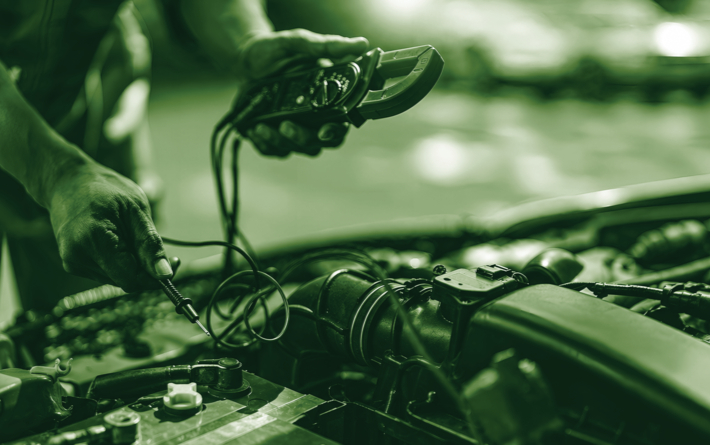
  1. Voltage Test with a Multimeter: With the engine off and car rested for at least an hour, set your multimeter to DC voltage and connect to the terminals. A healthy battery reads 12.6V or above. 12.4V indicates partial charge. Below 12.2V signals a weak battery. Below 12V means it's likely failing.
  2. Load Test: A more accurate test done at a service centre. The battery is put under simulated load (equivalent to engine cranking) and its voltage drop is measured. A battery that can't maintain above 9.6V under load needs replacement.
  3. Observe Cranking Behaviour: Time how long the engine takes to fire up across several mornings. Any increase in crank duration over days or weeks is a reliable early warning.
  4. Electrolyte Level Check (for non-sealed batteries): If your battery has removable caps, check that the fluid covers the plates. Plates exposed to air are being damaged each time the battery operates.

Battery Maintenance: Prolonging Battery Life

A well-maintained battery lasts significantly longer than a neglected one. These habits are practical for any Indian car owner:

Keep Terminals Clean

Disconnect the battery terminals periodically and clean any corrosion with a mixture of baking soda and water using an old toothbrush. Rinse, dry thoroughly, and reconnect. Apply a thin layer of petroleum jelly or terminal grease to prevent future oxidation. This alone improves conductivity and reduces the load on the alternator.

Avoid Short Trips Whenever Possible

Every engine start draws a significant charge from the battery. The alternator needs at least 20-30 minutes of running at moderate RPM to fully replenish what was used. Habitually doing 5-10 minute drives without longer runs in between slowly depletes the battery's reserve capacity.

Don't Leave Electronics Running When Parked

Music, AC fans, lights, or phone chargers running with the engine off all drain the battery. Even keyless entry systems and alarm units draw a small background current constantly - called a parasitic drain. If your car sits unused for more than 10-14 days, consider using a trickle charger.

Park in Shade When Possible

Consistently parking in direct sun subjects the battery to sustained thermal stress. Shaded or covered parking - especially during April-June - can meaningfully extend battery life in high-temperature cities.

Have It Tested Annually

Battery health should be checked professionally at least once a year - ideally before summer and before winter in northern India. A load test gives a far more accurate picture than a voltage reading alone and helps you plan a replacement before an unexpected failure.

Ideal Car Battery Maintenance Schedule

FrequencyTask
Every 2 weeksVisual check - look for cracks, swelling, or leaks
Every monthCheck terminal corrosion; clean if needed
Every 3 monthsCheck electrolyte level (conventional batteries only)
Every 6 monthsMeasure resting voltage with a multimeter (target ≥12.6V)
Every yearFull load test at a service centre
Every 3-4 yearsConsider proactive replacement in Indian conditions

How to Maximise Battery Life in Indian Conditions?

Beyond routine maintenance, a few habits make a disproportionate difference to how long your battery lasts:

  • Take your car for at least one drive of 30+ minutes per week - city commuters especially benefit from the occasional highway run
  • Service your alternator and charging system as part of your regular car service - a faulty alternator silently kills batteries through under or overcharging
  • Avoid aftermarket electrical additions without proper wiring - poorly installed accessories create parasitic drains that deplete the battery overnight
  • Use the correct battery specification for your vehicle - don't substitute a lower Ah rating to save cost; undersized batteries fail faster
  • Secure the battery properly in its mount - vibration from Indian roads loosens internal plates over time if the battery is not firmly clamped
  • Turn off all accessories before switching off the engine - this reduces the initial load on the battery when you start next

Factors to Consider When Buying a Car Battery in India

With dozens of options on the market, here's what actually matters when choosing a replacement:

Correct Group Size

Every car has a specified battery group size based on the tray dimensions, terminal positions, and electrical requirements. Refer to your owner's manual or the existing battery label. Never install a battery that doesn't physically fit or match the terminal orientation.

Amp Hour (Ah) Rating

The Ah rating reflects how much energy the battery can store and sustain. Match or slightly exceed your vehicle's specified rating. Avoid under-speccing - a lower Ah battery will struggle under load and fail sooner.

Cold Cranking Amps (CCA)

CCA measures how much current the battery can deliver at low temperatures. For most of India this is less critical, but for North Indian winters or hill regions, a higher CCA rating provides better reliability on cold mornings.

Reserve Capacity (RC)

RC indicates how long the battery can power essential systems if the alternator fails. A higher RC gives you more time to reach help in a roadside emergency.

Technology (MF vs AGM)

For most modern cars in India, a sealed maintenance-free (MF) battery is the practical choice. If your car has a start-stop system or high electrical demand, AGM is worth the additional cost.

Warranty

Reputable battery brands in India offer 24-48 month warranties, often with pro-rated replacement terms. Understand the full warranty period vs. the free replacement period before buying.

Date of Manufacture

Batteries lose capacity while sitting in storage. Always check the manufacturing date on the battery - buy one manufactured within the last 3-4 months for best performance.

Car Battery Replacement: Step-by-Step

Replacing a car battery is one of the more straightforward DIY tasks - but it must be done in the correct order to avoid electrical issues or damage to onboard systems.

  1. Switch off the engine and all accessories. Remove the key from the ignition.
  2. Locate the battery - usually in the engine bay, sometimes under the rear seat or in the boot in newer models.
  3. Identify the positive (+) and negative (−) terminals. Always disconnect the negative terminal first to avoid short circuits.
  4. Remove the negative cable, then the positive cable. Use an appropriate spanner - 10mm is most common in Indian cars.
  5. Remove the hold-down clamp or bracket securing the battery in its tray.
  6. Lift the old battery out carefully - car batteries are heavy (typically 12-20 kg). Keep it upright.
  7. Clean the battery tray and terminal connectors with a wire brush and baking soda solution if corrosion is present. Let dry completely.
  8. Place the new battery in the tray in the correct orientation - positive terminal aligned with the positive cable.
  9. Secure the hold-down clamp firmly. A loose battery vibrates and damages internal plates.
  10. Connect the positive cable first, then the negative. Tighten securely.
  11. Apply terminal grease to both terminals to prevent future corrosion.
  12. Start the engine and verify all electrical systems are functioning normally.

Important: Some modern cars reset infotainment settings, power window positions, or require steering calibration after a battery replacement. Check your owner's manual for any battery disconnect procedures specific to your model.

Quick Fix for Car Starting Troubles - and When to Call for Help

A car that won't start is one of the most stressful roadside situations. Here's how to handle it:

If Your Car Won't Start Right Now

  • Check if interior lights and dashboard illuminate: If nothing powers on, the battery is likely fully discharged or disconnected

    If lights work but engine won't crank, the battery may be too weak to deliver starting current - a jump-start can get you going temporarily

  • For a jump-start, connect positive to positive and negative to the negative terminal (or a metal earth point on the dead car). Start the donor vehicle first, then the dead car. Run for at least 20-30 minutes after to partially recharge
  • If the engine cranks but won't fire, the issue may not be the battery at all - fuel, ignition, or sensor faults are possible

When the Battery Needs Professional Attention?

Jump-starting a dead battery gets you moving, but it doesn't diagnose or fix the underlying problem. If your battery is failing, draining overnight, or simply reaching the end of its life, you need it tested and replaced properly - ideally without the hassle of driving a struggling car to a workshop.

This is where Amaron Assist comes in. Amaron Assist dispatches certified automotive technicians directly to your location - home, office, or roadside - for battery health checks, doorstep battery replacement, and jump-start assistance. Backed by Amara Raja Energy & Mobility, the maker of Amaron batteries, the service combines technical expertise with the convenience of not having to move your vehicle anywhere.

Book through WhatsApp or the Amaron Assist website, and a technician arrives at a time that works for you, equipped to handle the job on the spot.

Maintaining the Health of Your Car Battery: The Long Game

Battery maintenance isn't a single event - it's a small collection of consistent habits that compound over years. Here's the complete picture for Indian car owners:


HabitWhy It MattersFrequency
Clean terminalsReduces resistance; improves charge transferMonthly
Check resting voltageCatches capacity loss before failureEvery 6 months
Take longer drives regularlyAllows full recharge from alternatorWeekly
Avoid electronics on a parked carPrevents parasitic drainEvery time
Park in shadeReduces thermal degradationDaily in summer
Professional load testMost accurate health assessmentAnnually
Check manufacturing date when buyingEnsures you get a fresh batteryAt purchase

The average Indian car owner replaces their battery reactively - after a breakdown. The owners who get 4-5 years from a battery in Indian conditions are the ones who check, clean, and test proactively. The cost difference between preventive maintenance and an emergency replacement isn't just money - it's the peace of mind that your car starts every single morning.

Frequently Asked Questions

  • What is the normal life of a car battery in India?

    In Indian conditions, most car batteries last between 3 and 5 years. In high-heat cities like Delhi or Nagpur, the realistic expectation for a standard battery is 2.5-3.5 years. AGM batteries, better suited to heat and frequent restarts, can last 4-5 years. Driving pattern, maintenance habits, and parking conditions all influence the actual lifespan significantly.

  • Which brand of car battery is best in India?

    Amaron and Exide are the two most trusted car battery brands in India, both offering wide model ranges, strong warranty terms, and service networks. Amaron batteries are manufactured by Amara Raja Energy & Mobility and are particularly well-regarded for their heat tolerance and maintenance-free performance in Indian conditions. The best battery for your car is one that matches your vehicle's specifications in Ah rating, group size, and terminal position - brand alone is not sufficient.

  • Is a 7-year-old car battery still good?

    In most cases, no. A 7-year-old car battery in India has almost certainly degraded significantly - even if it appears to work. Batteries lose capacity gradually, and by year 5-6 in Indian conditions, most are operating well below their original rating. A battery that old is a reliable failure waiting to happen. Have it load-tested immediately, and plan for replacement regardless of the result.

  • How do I know if my car battery needs replacement?

    The clearest signs are a slow or sluggish engine crank, dim headlights, a battery warning light on the dashboard, a swollen battery case, or the need for repeated jump-starts. If your battery is over 3 years old in Indian conditions, get it professionally load-tested annually. Don't wait for a complete failure - proactive replacement is always less costly and inconvenient.

  • Can I replace a car battery myself?

    Yes, for most cars it's straightforward - disconnect the negative terminal first, then positive; remove the old battery; install the new one in reverse order. However, some modern vehicles with complex electrical systems can experience issues after a battery swap, such as ECU resets or window calibration loss. If you're unsure, a professional doorstep service like Amaron Assist can handle the replacement safely at your location.

idea

In the domain of two-wheeler batteries, Amaron emerges as a symbol of reliability. Their products are meticulously designed using advanced technologies to ensure longevity.